As a post-doctoral fellow in the Plasma Lab at Case in Cleveland, I took on the experimental challenge of building a high-current magnetic compression device called a plasma focus. This experience was very positive because I became knowledgeable at detecting neutrons and developing plasma diagnostic techniques. These skills led me to be hired at a new start-up research company, KMS Fusion in Ann Arbor, Michigan. KMSF was founded by entrepreneur and University of Michigan physicist, Keeve M. Siegel. The company was technically led by Keith Brueckner, a well-known University of California, San Diego, physicist.
KMS Fusion’s goal was to make use of high-powered lasers to drive an implosion of a spherical capsule filled with deuterium(D) and tritium(T) gases to densities and temperatures high enough for thermonuclear reactions in sufficient quantities to develop laser fusion power reactors.
One of my first KMSF projects was to provide a quantitative measurement of a pulse of neutrons from the laser driven implosion of DT-filled spherical glass shells.
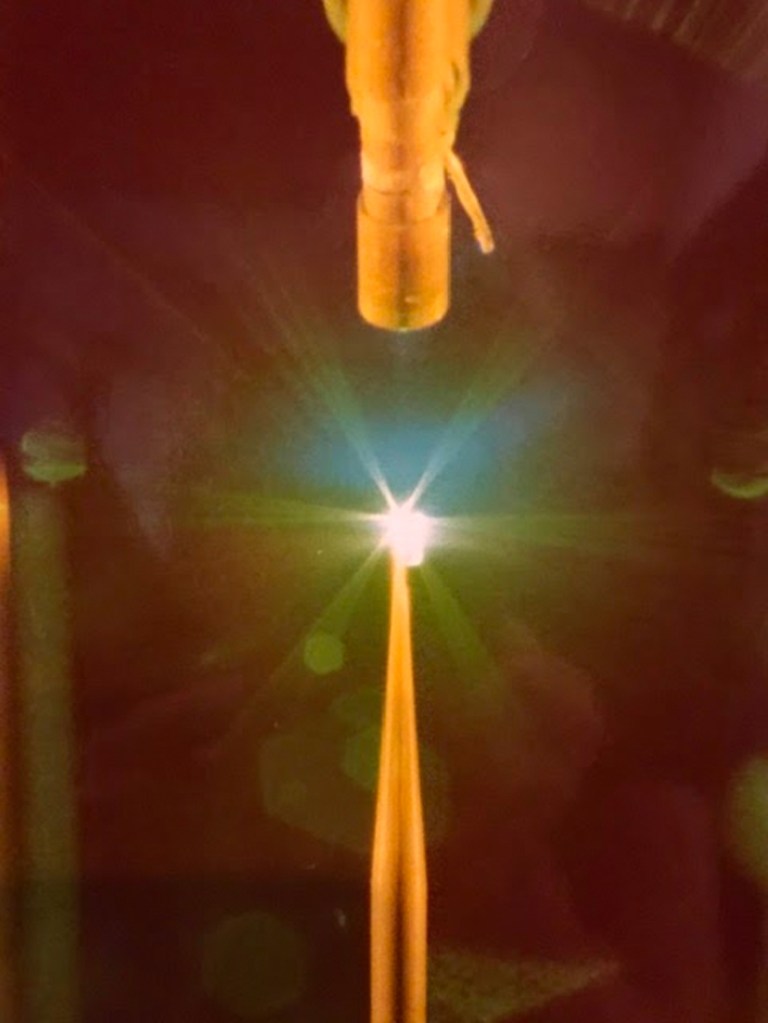
Later, I was asked to head-up the plasma diagnostics group and was involved in other experiment-specific diagnostics that included capturing the ions expanding from the laser-target implosion.
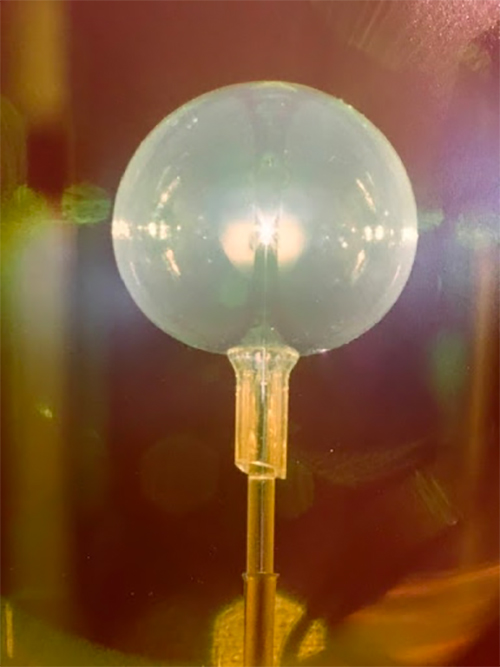
Next, I led the fusion experiments group and then the advanced research group. By 1974, we had produced experiments that yielded about 107 to 108 neutrons in a single implosion. This was an important event for KMSF as it was the first successful experiment of its kind. However, attempts to increase the neutron yield per laser pulse were unsuccessful.
Although the laser-fusion program continues in national laboratories using concepts developed from nuclear weapons designs, the energy yield from the implosions is very low compared to the laser energy driving the implosions. Consequently, this very clever concept is far from being capable of developing a laser-fusion power reactor.
An interesting project undertaken by the advanced research group at KMSF was Project CHI. This project was motivated by implosion physics but made use of laser ignition of high-explosives to produce heating and compression of materials. Project CHI was successful at inducing a change from the graphite phase of boron-nitride into a diamond phase.

Selected Fusion Publications
G. Charatis, et al., “Experimental Study of Laser Driven Compression of Spherical Glass Shells”, IAEA-CN-33/F1 pages 317-335 and The Review of Laser Engineering (1974)v2;
See pdf: ExperimentalStudy
Mayer, F.J., and Brysk, H., “Neutron detection efficiency of silver counters,” (1975) Nuclear Instruments and Methods 125(2):323-324, DOI 10.1016/0029-554X(75)90288-8;
See pdf: NeutronDetection
Mayer, F. J., and Rensel, W. B., “Plastic bubbles and tamper (ρ R) measurements for laser driven fusion experiments”, (1976) Journal of Applied Physics 47(4): 1491-1495; DOI 10.1063/1.322814;
See pdf: PlasticBubbles
Mayer, F. J., Fechner, W. B., Maynard, R. L., Schmerberg, N. W., Wixom, M. R., “Shock processing of materials with laser initiated spherically convergent detonations”, Journal of Applied Physics 64, 4896 (1988);
See pdf: ShockProcessing
 Frederick J. Mayer